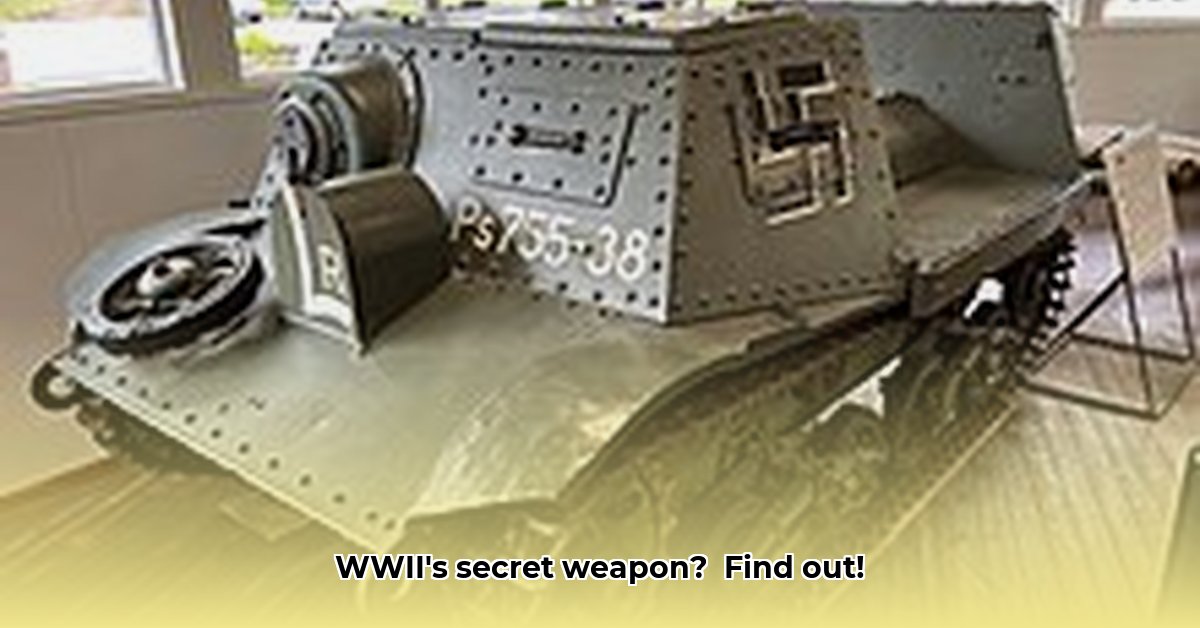
The Komsomolets T-20 armored tractor—a name that hardly evokes images of fierce combat—played a surprisingly significant role in World War II. This unassuming vehicle, initially designed for agricultural purposes, became a testament to the Red Army's resourcefulness during a time of desperate need. Its journey from the fields to the battlefield is a compelling story of adaptation and the unexpected uses of even the most ordinary machines in the throes of war. For more on similar agricultural vehicles, see early agricultural tractors.
From Plow to Battlefield: A Farm Tractor's Unexpected Wartime Role
Initially conceived as a simple agricultural tractor for towing light artillery, the Komsomolets' design prioritized readily available materials. This pragmatic approach, born out of necessity, shaped its role in the war. With tank production struggling to keep pace with the demands of the Eastern Front, the Komsomolets filled a crucial, albeit unconventional, gap. It wasn't a purpose-built war machine; rather, it was a symbol of the Soviet Union's determined efforts to equip its army against the German onslaught.
More Than Meets the Eye: Combat Performance and Varied Roles
The Komsomolets' thin armor – a mere 7-10 millimeters – offered minimal protection against enemy fire, making survival a constant gamble. However, a crucial design feature – dual controls – significantly improved crew survivability by allowing quick driver changes in case of injury. Early accounts frequently depict the Komsomolets as a lightly armored scout, a temporary substitute for more sophisticated tanks. Later reports, however, suggest a broader range of uses, including troop transport (functioning as a makeshift armored personnel carrier) and even as a platform for mounting weaponry, although its effectiveness in these roles is a subject of ongoing historical debate. How frequently was the Komsomolets successfully used in these more aggressive roles? This question remains a subject of scholarly investigation.
Production, Deployment, and a Curious Twist: Enemy Adoption
Estimates of Komsomolets production vary widely, ranging from approximately 4,400 to nearly 7,800 units. These tractors saw action across the vast expanse of the Eastern Front, participating in some of the war's most brutal battles. Their simple design and the ease with which they could be repaired using readily available components contributed to their remarkable resilience despite their inherent limitations. Remarkably, captured Komsomolets tractors were even adopted and utilized by Axis forces, most notably German and Romanian troops. This speaks to the vehicle’s adaptability and the straightforward nature of its design, which allowed for easy repair and repurposing. This presents an intriguing paradox: Why couldn't more advanced war machines boast similar ease of repair and repurposing?
Design, Drawbacks, and Risk Assessment
The Komsomolets utilized a GAZ-M car engine, a choice dictated by wartime exigencies. While reliable, this engine proved underpowered for the demanding tasks often assigned to the tractor, particularly when towing artillery. The combination of thin armor and an underpowered engine significantly impacted its combat effectiveness. The following table summarizes the key risks associated with its use in combat:
| Feature | Risk Category | Likelihood | Impact | Mitigation Strategies |
|---|---|---|---|---|
| GAZ-M Engine | Mechanical Failure | High | Medium | Regular maintenance, improved cooling systems (in hindsight) |
| Thin Armor | Vulnerability | Moderate | High | Tactical maneuvers, prioritizing support roles |
| Spare Parts Supply | Supply Chain Issues | Moderate | Medium | Stockpiling by Soviet forces, scavenging by Axis forces |
The Komsomolets story offers a valuable case study in wartime adaptation and resourcefulness. Its true impact on the war effort remains a subject of ongoing historical discussion, but its endurance and adaptability nonetheless stand as testaments to resilience and ingenuity on the Eastern Front.
Modeling Komsomolets T-20 Combat Effectiveness in Wargame Simulations
The Komsomolets T-20’s role in World War II was multifaceted and often depended on specific circumstances. How can we accurately represent its effectiveness in wargame simulations? This challenge requires a multi-pronged approach:
Establish Base Stats: Accurately define the T-20's attributes (armor, speed, range, firepower) within the game's engine, using the most reliable data available.
Define its Role: Model the T-20 primarily as a support vehicle, reflecting its strengths in towing, supply transport, and limited defensive capabilities.
Assess Vulnerability: Integrate its thin armor into the simulation, making it highly vulnerable to anti-tank weapons and even heavy machine gun fire.
Simulate Scenarios: Test the T-20 in diverse scenarios to evaluate its performance in towing artillery, transporting supplies, and facing enemy fire.
Iterative Refinement: Continuously compare simulation results with historical accounts of T-20 usage, refining the model based on discovered discrepancies and new information.
The use of 3D models offers an additional layer of detail, allowing for a more precise virtual representation of the vehicle's physical characteristics and design. Moreover, accurate simulation demands a contextual understanding of the Eastern Front's terrain, weather conditions, and the Red Army's tactical doctrines. The Komsomolets remains an intriguing subject of historical inquiry, and through careful research and simulation, a more complete understanding of its wartime role can be achieved.